
There is a category of game that is good and that you should not start after eleven at night. Most of the roguelike shelf lives there. The form is built on momentum — a run that improves, a counter that climbs, a reward that appears just before the point where you meant to stop — and momentum is precisely what a tired person cannot afford.
Three Doors is a roguelike that has been designed by somebody who understood this and treated it as the central problem rather than a side effect. It is the highest-scoring game on this site and it earns that position less through brilliance than through restraint.
Fourteen minutes, and the game says so
A run is a sequence of rooms. Each room takes between ninety seconds and four minutes, and before you enter one the game tells you roughly how long it will take. Not in a menu, not in a tooltip: on the door itself, as part of the choice between the three exits.
This single decision changes the character of the whole game. Choosing a door is no longer only a question of what reward lies beyond it, but of whether you have that much of the evening left. Twice in twenty-seven evenings we took the shortest of three doors purely because it was late, which is a decision no other game in this file has ever offered us.
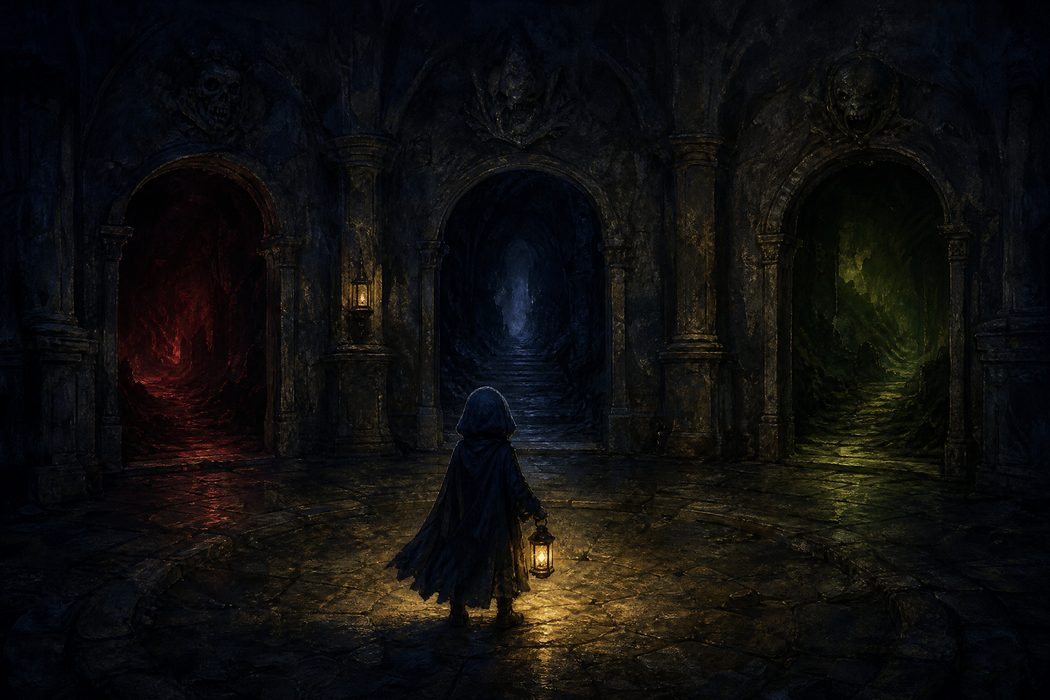
The save is between rooms, and it is complete
Quitting between rooms preserves everything: inventory, run modifiers, the map, the door you had not yet chosen. Resuming puts you back at the same antechamber with the same three doors and no penalty, no reduced reward and no note about having abandoned a run.
That completeness matters more than the frequency. Several games in the file save constantly and still cannot be left, because what they save is a position rather than a state you would want to return to. Here the resumed run is indistinguishable from an unbroken one.
| Measurement | Figure | Note |
|---|---|---|
| Honest session length | 14 min | Median across 27 evenings; shortest in the file |
| Intended vs actual | +1 min | The smallest overrun we have recorded |
| Save granularity | Per room | Full state, including unspent choices |
| Time to first input | 19 sec | Cold start to controlling a character |
| Resume clarity | Complete | Run modifiers restated on load |
| Stop quality | Clean | No progress lost at any point |
What it does not do
There is no streak bonus. There is no daily challenge with a countdown. Completing a run does not immediately offer a new one with a modifier attached, and the results screen has no button that starts another attempt — you return to a menu, and starting again takes two deliberate inputs.
Every one of those absences is a mechanic that other games in this file possess, and every one of them is a mechanism for converting a twenty-minute session into an hour. Their absence here is not an oversight; the game's own notes describe the results screen as a stopping point.
Nineteen seconds from launch to control, fourteen minutes to a complete run, two deliberate inputs to begin another. Those three figures describe a game that expects you to have a life.
Whether it is actually good
All of the above would be worth little if the game underneath were thin, and this is where Three Doors surprised us. The room design is genuinely sharp: three exits, each with a stated cost in time and an implied cost in risk, and a small enough set of systems that a fourteen-minute run can express a real strategy.
Forty-one hours in, we are still finding combinations we had not tried. The build variety is narrower than the largest games in the genre and the art repeats sooner than we would like, but the moment-to-moment decisions hold up, and holding up is what forty-one hours tests.
The one complaint
The audio mix is louder than it needs to be and has no separate slider for the impact sounds, which at low volume become inaudible before the ambient layer does. On five evenings we played with the sound off entirely, and the game lost something.
For a game this carefully considered in every other respect, the absence of a low-volume mix is a strange gap. It costs it a tenth of a point and it is the only note in three pages of our log that describes a fault rather than a decision.
Verdict
The best late-night game we have measured, and the only one that appears to have been designed with a clock on the wall in mind. Its run length is honest, its save is complete, its exit is unpunished, and the game inside all that scaffolding is good enough to sustain forty hours.
Score
9.1/10
Fourteen-minute runs, per-room saving, duration estimates on every choice and no mechanism anywhere for extending a session against your will. Stop quality: clean.