
This is the most frustrating entry in the file, because the game is better than anything else here and the grade beside it is the second-worst. Forty-four hours in we still want to play it, and we have learned not to open it on a weeknight.
The problem is not length. The driving game elsewhere on this site has sessions almost as long and is graded clean, because it ends where you decide it ends. The problem here is unpredictability, which is a category of design failure we had not appreciated before this game demonstrated it.
The deduction itself is superb
A case is a spread of cards, each carrying a geometric symbol whose meaning is established by the case rather than fixed across the game. Establishing what a symbol means in this particular case is the puzzle; using it to eliminate suspects is the payoff.
What lifts it above its peers is that the game never lies and never withholds. Every case is solvable from the cards on the table at the moment they are dealt. We solved forty-one of forty-seven cases without a wrong accusation, and every one of the six failures was our error rather than a hidden variable.
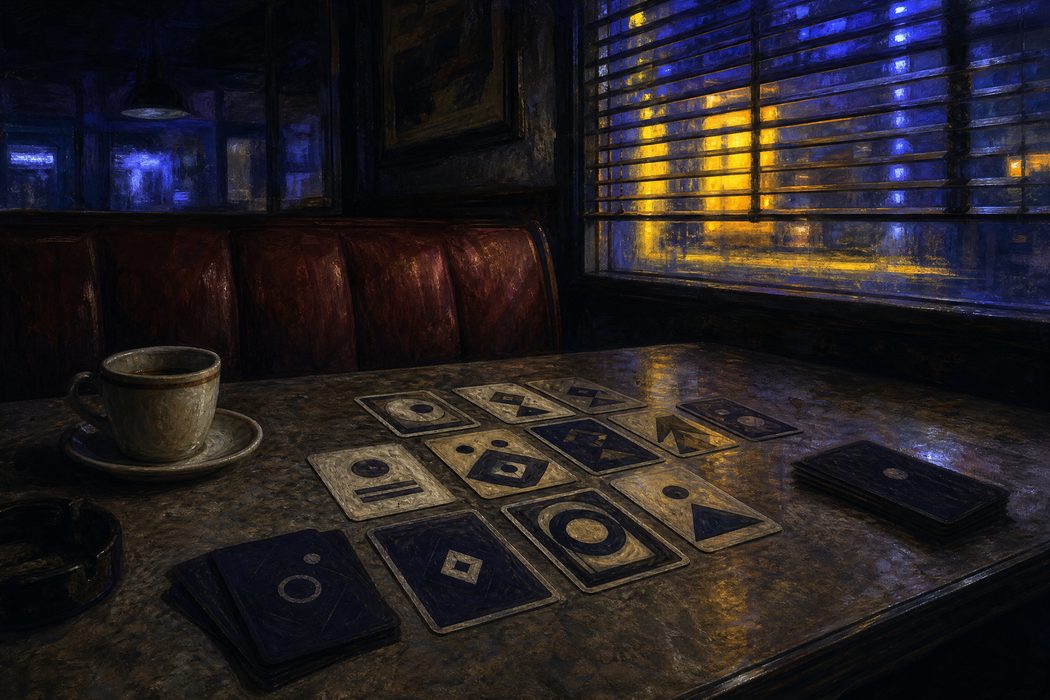
And then the case will not close
Progress — unlocked symbol sets, the case log, everything the campaign tracks — commits when a case closes. Quitting mid-case discards the board entirely. Not the progress toward the case, the board: on return, a new spread is dealt.
Our shortest case was twenty-nine minutes. Our longest was one hour and thirty-four. The distribution is wide, roughly flat, and completely opaque from the opening spread. Deciding to play one case is therefore deciding to spend somewhere between half an hour and an hour and a half, with no information about which.
| Measurement | Figure | Note |
|---|---|---|
| Honest session length | 38 min | Median across 23 evenings |
| Intended vs actual | +21 min | Second-largest overrun here |
| Case length range | 29m – 1h34 | Not predictable from the opening spread |
| Save granularity | Per case | Mid-case state discarded on quit |
| Abandoned sessions | 6 of 23 | Evenings that produced nothing |
| Stop quality | Sticky | Progress waits on an unpredictable milestone |
Six evenings that produced nothing
The figure above is the one that decided the grade. On six of twenty-three evenings we started a case, ran out of time, and quit with nothing recorded — a quarter of our sessions with this game produced no progress at all despite averaging thirty-eight minutes of play.
No other game in the file does this. Even the hostile tower defence game at least tells you what a map costs before you enter it, so a bad decision is a decision. Here the information required to make the choice does not exist.
A long session you chose is not a problem. A session of unknown length that discards everything if you guess wrong is a different thing, and it is what sticky means.
What would fix it
A saved case would resolve it completely, and the game clearly can serialise a board because it deals a reproducible spread from a seed. Failing that, a difficulty or length indicator on the opening spread would at least let a tired person decline.
We would also accept partial credit: symbols identified during an abandoned case remaining known. That alone would turn six wasted evenings into six short ones.
Verdict
The best game on this site and the wrong one for a weeknight, which is precisely the split this publication exists to describe. Play it on an afternoon. Do not open it at half past ten expecting to be in bed by eleven, because the game has no idea how long it is going to take either.
Score
7.9/10
Exceptional deduction design — honest, solvable, never arbitrary — attached to a commit point that arrives somewhere between twenty-nine and ninety-four minutes in, with nothing preserved if you leave first. Stop quality: sticky.